
EHR Implementation Cost: The Eight Weeks Nobody Is Watching
EHR implementation cost is where these deals quietly die. Every vendor thinks the deal was lost on price or features. It was lost when the person who has to run the thing priced his own department in his head, and nobody had given him a number. This is what that costs, week by week, and what it means whether you are buying or selling.

EHR implementation cost is the total of the licence fee, the integration work, and the hours your own staff give up during rollout. Staff time is usually the largest line and the one no quote shows. Budget eight weeks of it per department.
Every software vendor thinks they lost on features. They almost never did. The committee looked at the quote, then looked at each other, and one person asked the question that ended it: who covers the shift while our people are in training.
Nobody answered. The deal went quiet. The vendor went home and added a feature.
What EHR implementation cost actually means
There are three lines, and only one of them appears on the proposal.
- The licence. Per seat, per bed, per provider, per year. This is the number everyone argues about, and it is the smallest of the three.
- The integration work. Interfaces, data migration, testing, the security review. Some of this is quoted. Most of it is quoted as a range.
- Your own staff time. Training, parallel running, the drop in throughput while people learn, the person who becomes the internal expert and stops doing their real job. None of this is quoted, and it is the biggest line.
A buyer who has been through one rollout knows all three. A vendor who has only ever sold knows one. That gap is the whole problem.
The EHR implementation cost breakdown nobody sends you
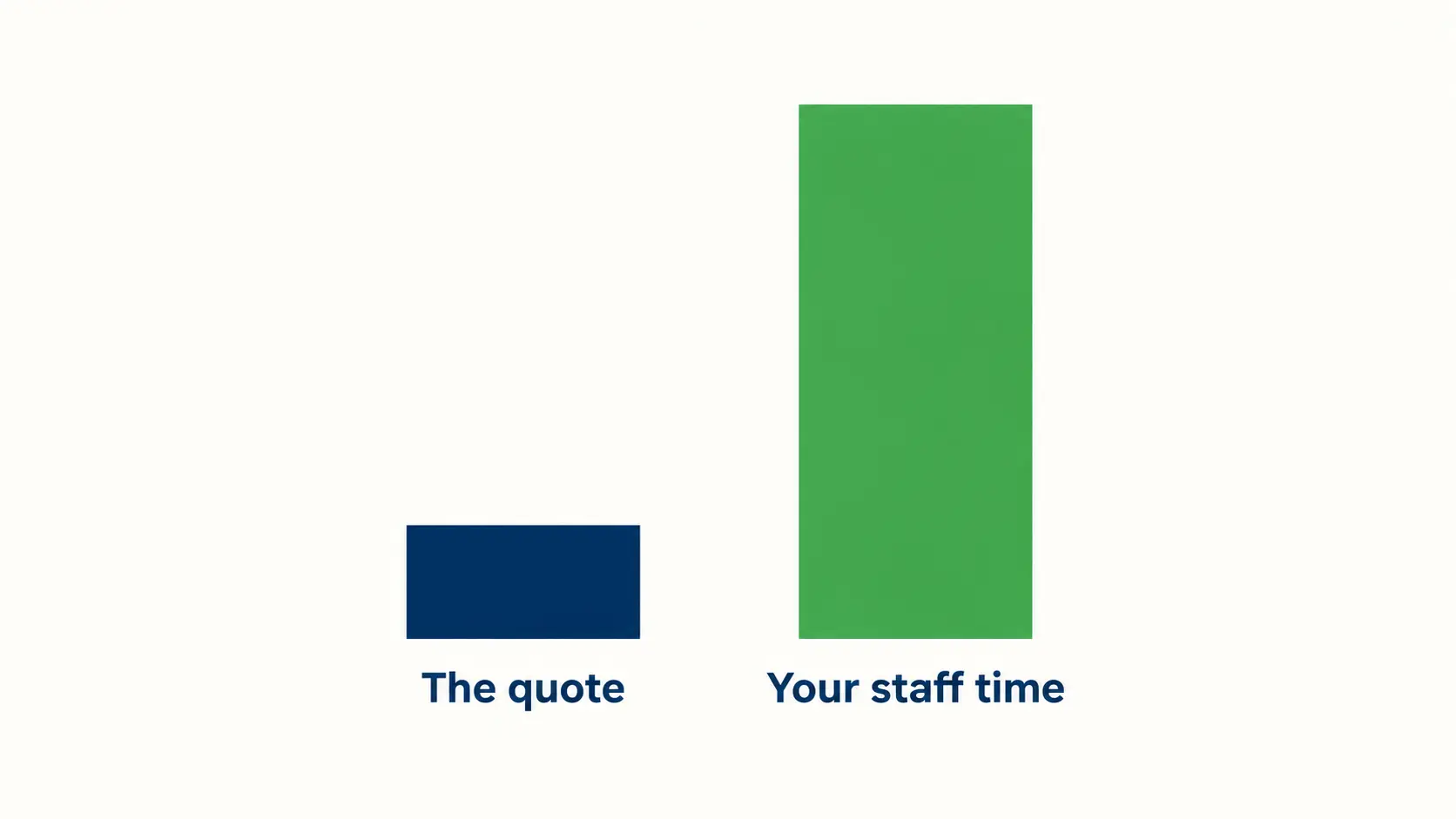
Ask a hospital operations lead to break the cost down and they will not start with money. They will start with people. The breakdown that decides the purchase looks like this.
- Clinical hours lost to training. Every clinician who trains is a clinician not seeing patients.
- The slowdown after go live. Real throughput drops before it recovers. Everyone knows this and almost nobody writes it down.
- The internal project owner. One capable person is removed from their normal work for the length of the project, and often longer.
- The second round. Whatever was configured wrong in week two gets fixed in month four, by the same people.
- The exit risk. If it fails, the cost of going back is higher than the cost of going forward, and the committee knows that before it signs.
Notice that four of those five are staff time. That is why a cheaper licence rarely wins.
How much does EHR implementation cost in staff hours
There is no honest single number, and anyone who gives you one is selling. What there is, reliably, is a shape.
The shape is eight weeks per department where the department is running two systems, or one system badly, while it learns. Small clinics compress it. Large hospital groups multiply it by the number of departments and then discover the departments cannot all go at once, because the same trainers and the same internal expert are needed in each.
Multiply eight weeks by a fully loaded clinical hour and you have a number that dwarfs the licence. That is the number the committee is actually approving. It is never on the proposal.
Run the Growth Qualifier and see whether your growth problem is reach or scoping. Two minutes, and you see the verdict without leaving an email.
The hidden costs inside EHR implementation cost
Hidden is the wrong word. They are not hidden from the buyer. They are hidden from the vendor, because the buyer has no reason to explain them to someone who is trying to sell.
- The compliance review. Weeks, not days, and it starts after the commercial terms are agreed, which is why deals stall at the last step.
- Data cleaning. Migrating a decade of records means confronting a decade of bad records. The vendor calls it migration. The buyer calls it the reason the timeline slipped.
- The workflow rewrite. Software encodes a process. If the process changes, so does everyone’s day, and someone has to own that change.
- The reference call. Not a cost, but a gate. Whoever cannot produce a site of the same size running the same set does not get to the final round.
The EHR implementation timeline, week by week

The eight weeks are not the whole project. They are the part where the organisation is carrying the load and getting nothing back yet. That window is what people remember, and it is what they price into the next decision.
- Weeks one and two. Configuration and interface work. Quiet. The vendor feels good about this stage.
- Weeks three and four. Training. The first real cost lands. Rotas get rewritten.
- Weeks five and six. Parallel running. Two systems, double entry, tempers.
- Weeks seven and eight. Cutover and the dip. Throughput falls, tickets spike, the internal expert stops sleeping.
Ask a vendor to describe week six and you learn immediately whether they have done this before. Most describe week one.
Why EHR implementation fails, and what it does to EHR implementation cost
EHR implementation cost overruns rarely come from the software. They come from capacity. The organisation agreed to a plan that assumed people had time they did not have, and then the plan met a bad flu season, or a resignation, or an inspection.
The vendors who win the second and third deal in a market are the ones who arrived with the eight weeks already mapped and staffed. Not a feature list. A staffing plan for someone else’s hospital. That is the whole difference, and it is a commercial move, not a product one.
What this means if you sell the software
If you are the vendor, read the section above again as a diagnosis of your own pipeline. EHR implementation cost is not your problem to pay, but it is your problem to answer.
Your last five lost deals were probably not lost on price or features. They were lost the moment a buyer could not see how the eight weeks would be covered, and had no way to ask you without sounding difficult. So they went quiet instead.
The test you can run this week. Take your last five closed lost deals. Call one contact at each and ask a single question: what did you assume the rollout would cost your own staff. Do not defend anything. Just write down the answer. If four of the five give you a number in weeks rather than dollars, your problem was never the product.
That is a decision problem, not a lead problem. It is what the Commercial Growth System is built to fix, and it is why the first step is a verdict rather than a proposal.
Get my verdict. No card required.
Healthcare software implementation services, and how to judge EHR implementation cost in a proposal
Whether you buy or sell, the same four questions separate a real implementation partner from a slide deck.
- Name a site of our size running the same set. Not a logo, a site.
- Describe week six of a rollout you personally worked on.
- What did your last client do about coverage during training, and what did it cost them.
- What went wrong on your last go live, and who found it first.
Anyone who cannot answer the fourth question has either never gone live or is not going to tell you the truth about your project either.
What we do about it
We work with software and device vendors selling into decisions like this one, in the US, Europe and the Gulf. The work is not more leads. It is making the buyer’s real objection visible early enough to answer it, so the deal does not go quiet at the last step.
For proof that this travels outside one market, see a US healthcare client we took from 120 to 635 organic clicks a month, a 429 percent increase verified in Google Search Console, and a GCC B2B case with zero ad spend.
Run the Growth Qualifier. Two minutes, and you get a verdict on whether your growth is a reach problem or a decision problem.
FAQ: EHR Implementation Cost
How much does EHR implementation cost?
There is no single honest figure, because the largest line is not money leaving the building. It is your own staff time, and that varies with department size, how many systems run in parallel, and how clean the existing records are. A useful way to size it is to take the licence quote, take the integration quote, then add eight weeks of reduced output per department that goes live. Multiply those weeks by a fully loaded clinical or administrative hour and you usually find the internal cost is several times the quoted cost. Any vendor who gives you one confident number for a hospital they have not surveyed is quoting the licence and calling it the project.
What is included in an EHR implementation cost breakdown?
Three groups. First, the licence, priced per seat, per bed or per provider. Second, the implementation work itself: interfaces to the systems you already run, data migration, testing, the security and compliance review, and configuration. Third, and largest, your own people: training hours, parallel running, the drop in throughput after go live, and one capable internal person removed from their normal job for the length of the project. Most proposals quote the first group precisely, the second as a range, and the third not at all. When a committee compares two vendors, it is the third group it is really arguing about, even when the conversation sounds like it is about price.
Why does EHR implementation take so long?
Because the constraint is people, not software. Configuration can be quick. Training cannot, because the same clinicians who need training are the ones seeing patients, and the same internal expert is needed by every department that goes live. Add the compliance review, which starts after commercial terms are agreed and runs in weeks rather than days, and add data cleaning, which forces the organisation to confront years of imperfect records. A timeline that assumed people had spare capacity meets a bad season, a resignation or an inspection, and slips. The eight week window per department is the part where the organisation carries the load and gets nothing back yet.
What are the hidden costs of EHR implementation?
They are not hidden from the buyer. They are hidden from the vendor, because a buyer has no reason to explain them to someone trying to sell. The main ones are the compliance review, data cleaning, the workflow rewrite that changes everyone’s day, coverage for staff who are in training, the productivity dip after cutover, and the second round of fixes in month four for whatever was configured wrong in week two. There is also an exit cost that never appears anywhere: once a rollout starts, going back is more expensive than going forward, and the committee knows that before it signs.
Why do EHR implementations fail?
Rarely on the software. Almost always on capacity. The plan assumed staff time that did not exist, and there was no agreement about who covered the gap. The failure shows up as a slipped timeline, then as a half used system, then as a renewal that does not happen. The vendors who avoid this arrive with the rollout already mapped and staffed for that specific organisation, including who covers the shift during training. That is a commercial answer, not a product one, and it is the single strongest differentiator in a market where the products look alike on paper.
How do I compare healthcare software implementation services?
Four questions separate a real partner from a slide deck. One, name a site of our size running the same set, a site rather than a logo. Two, describe week six of a rollout you personally worked on. Three, what did your last client do about coverage during training and what did it cost them. Four, what went wrong on your last go live and who found it first. The fourth is the one that matters most. Anyone who cannot answer it has either never gone live or will not tell you the truth about your project either.
I sell the software. How do I know if this is why my deals stall?
Run one test. Take your last five closed lost deals, call one contact at each, and ask a single question: what did you assume the rollout would cost your own staff. Do not defend anything, do not pitch, just write the answer down. If four of the five answer in weeks rather than in money, you were never losing on price or features. You were losing because the buyer could not see how the eight weeks would be covered and had no comfortable way to ask. That is a decision problem, and it is fixed by changing what you say before the first call, not by adding another feature.
Does EHR implementation cost differ for hospitals and clinics?
Yes, and not in the way most quotes suggest. A small clinic compresses the whole cycle, often into a few weeks, because there are fewer people to train and one workflow to change. A hospital group cannot simply multiply that by the number of departments, because the same trainers, the same internal expert and the same compliance reviewers are needed in each one, so departments queue. That queue, not the licence, is what makes a large rollout expensive. It is also why a reference site of the same size and shape carries more weight in the room than any feature comparison.
Is Your Growth Problem Reach, or Scoping?
Fifteen questions, about two minutes, and a verdict rather than a proposal. No email needed to see your result.
Pingback: Medical Device Marketing Agency: The 15 Query AI Test