
MedTech SEO: How I Built the Engine Behind 429% More Organic Clicks in 4 Months
Most MedTech SEO advice starts with content calendars. Ours starts with a research engine that decides what is worth writing before a single article gets drafted, the same engine that took one US pharmacy client from 120 to 635 monthly organic clicks in four months, fully GSC-verified.

MedTech SEO is not a content problem, and treating it like one is why so many device makers, clinics, and pharmacy brands publish more articles every quarter and still cannot explain why their organic traffic barely moves. The bottleneck almost never sits in the writing. It sits one layer earlier, in the research that decides what is worth writing in the first place.
That earlier layer is what I mean when I talk about an engine rather than a content plan. A MedTech SEO engine is a repeatable research process that pulls real search volume, real difficulty scores, and real commercial intent for a given market before anyone opens a document to start drafting. It is slower to start and faster to compound, because every article it produces is already aimed at a term someone in that market is actually typing.
Most agencies skip this step because it does not look like deliverable work. A blog calendar full of headlines looks like progress to a client. A spreadsheet of rejected keywords does not, even though the spreadsheet is the reason the calendar is worth anything. I built the engine behind this article’s numbers specifically to fix that gap, and I am walking through it in public because the healthcare and device companies who need this kind of research the most are usually the ones being sold the content-calendar version instead.
What MedTech SEO Actually Requires From a Research Engine
Healthcare and device buyers do not search the way a typical B2B audience does. A pharmacy customer, a clinic administrator, and a hospital procurement lead all arrive with different vocabulary, different urgency, and different levels of trust in what they read. This kind of engine has to account for all three before a single page gets built, which is a very different job from picking a topic that sounds relevant and writing 1,500 words about it.
In practice, that means every keyword candidate gets checked against three numbers, not one. Search volume tells you whether anyone is actually asking the question. Difficulty tells you whether you can realistically win the page within a reasonable window. Commercial intent, usually visible through cost-per-click data, tells you whether the person searching is close to a decision or just browsing. A term can look attractive on volume alone and still be a poor use of three weeks of content production.
This kind of engine is not a bigger content calendar. It is a smaller, sharper list of the handful of terms actually worth building a page around.

Inside the Engine: How MedTech SEO Keyword Decisions Actually Get Made
Here is the filter I run before any page in this system gets approved for production. First, does the exact-match term or a close variant show real, non-zero search volume in the target market, not a global default that hides whether anyone local is actually searching. Second, is the difficulty score low enough that a focused page has a realistic path to ranking within the engagement window, rather than competing head-on with national healthcare directories. Third, does the term carry commercial signal, visible in a non-zero cost-per-click, that separates a buyer close to a decision from someone doing early research.
Terms that fail all three get dropped immediately, no matter how appealing the volume number looks on its own. Terms that pass get ranked by the best balance of the three, not by volume alone, because a lower-volume term with low difficulty and clear buyer intent will usually outperform a high-volume, high-difficulty head term inside a real engagement window. That ranked shortlist, not a brainstorm, is what becomes the actual content plan.
Why This Matters More in MedTech Than in Most B2B Categories
Healthcare and device buyers are unusually skeptical of anything that reads like a sales pitch, and regulated categories add a second layer: claims have to be accurate, sourced, and defensible, not just persuasive. An engine that skips the research layer tends to produce confident-sounding content aimed at terms nobody searches, which is the worst combination in a category where trust is already hard to earn and easy to lose.
The Numbers Behind This MedTech SEO Engine: Smile Pharmacy NJ
The clearest proof of what a research-first MedTech SEO engine produces is Smile Pharmacy NJ, a US retail pharmacy client. Over four months, July to November 2025, with zero ad spend and a fully organic system built on this same research process, organic clicks grew 429 percent, from 120 to 635 per month. Impressions grew 3,132 percent, from 4,864 to 157,148 per month. The site earned 4 number-one Google rankings, and technical SEO issues dropped 92 percent, from 252 to 22. Every one of those figures is pulled directly from Google Search Console, not an internal estimate.
None of those numbers came from writing more. They came from writing the right pages, chosen by the same three-number filter described above, applied specifically to the pharmacy customer’s real search behavior rather than a generic healthcare keyword list. That distinction, choosing correctly before producing anything, is the entire premise behind why this category deserves its own research process instead of a repurposed general B2B playbook.
The research spreadsheet nobody sees is the reason the case study numbers exist. MedTech SEO wins get decided before the first sentence gets written.
Why the Same MedTech SEO Engine Works Across Different Regulated Markets
The research-first approach behind Smile Pharmacy NJ is not pharmacy-specific. The same filtering process, real volume, real difficulty, real commercial intent, checked market by market, powered Eco Clean KSA’s SAR 77,483 in verified organic revenue across 6 months in Saudi Arabia’s cleaning and facilities management sector, and Mis Egypt Travel’s 2,450 organic clicks from a standing start in Egypt’s Umrah and Hajj travel category, both sourced from Google Search Console and Google Analytics 4.
What connects a pharmacy in New Jersey, a facilities management company in Riyadh, and a travel agency in Cairo is not the industry. It is that every one of those results started with a filtered keyword shortlist instead of a broad content calendar. An engine built the same way would apply the identical filter to device manufacturers, multi-branch clinics, diagnostics companies, and health-tech platforms, which is exactly the vertical this research process is now aimed at.
What a Real SEO Audit Report Actually Surfaces
A proper MedTech SEO audit is not a page-speed checklist. It is the output of running a company’s existing content and target market through the three-number filter above, then reporting back exactly where the gap sits. In practice, that report answers a short set of questions.
- Which existing pages target terms with real search volume in the target market, and which were built around a guess?
- Where is the difficulty score low enough to realistically win within the next two quarters, and where is the company competing against national directories it cannot beat yet?
- Which terms show commercial intent, through non-zero cost-per-click data, versus which only attract early-stage browsing traffic?
- What does the technical foundation look like, indexation, site speed, structured data, compared to what it looked like before?
- Which three to five pages, if built or fixed first, would move the needle fastest inside a realistic engagement window?
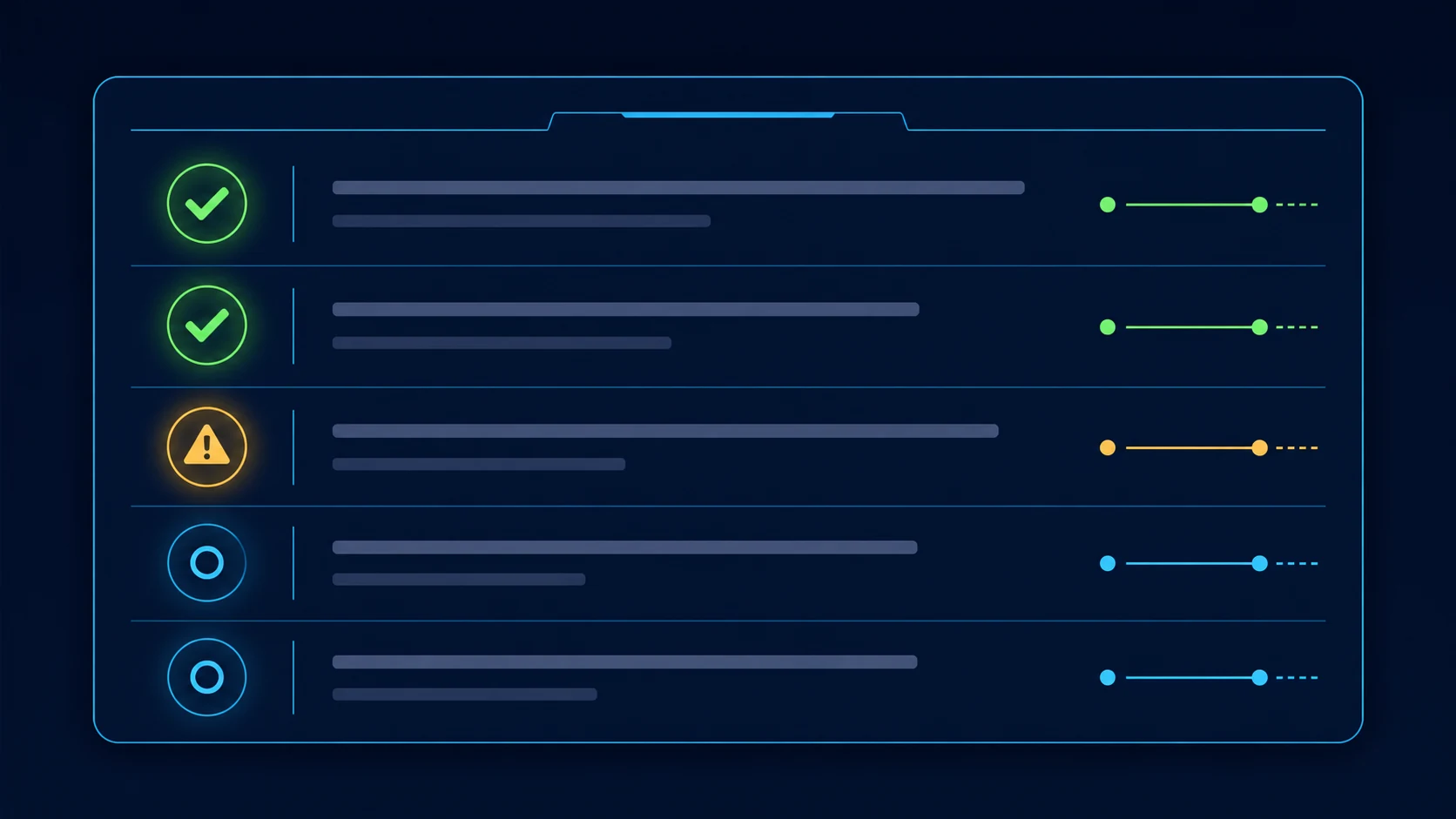
That last question is usually where this kind of SEO audit report earns its cost. Most healthcare and device companies already have more content than they think. What they are missing is the filter that tells them which existing pages are worth fixing, which new pages are worth building, and which ideas should simply be dropped.
What to Ask Any Healthcare SEO Agency Before You Hire One
Most healthcare and device companies shopping for outside help end up comparing a generic healthcare SEO agency against another generic healthcare SEO firm on price and promised timelines, without ever asking whether either one runs a real research filter before producing content. That is the wrong comparison. The right question is simpler: can this healthcare SEO agency show you the shortlist of terms it plans to target, with real volume, real difficulty, and real commercial intent attached, before it writes a single page?
The same test applies whether you are evaluating independent healthcare SEO consultants, a full-service healthcare SEO agency, or a narrower set of healthcare SEO services bundled into a broader marketing retainer. If the answer to that question is a content calendar instead of a filtered keyword list, you are buying activity, not a system built to produce results like the ones above.
The Cost of Skipping the Research Layer in MedTech SEO
Skipping the research layer does not usually look like failure right away. It looks like steady output: new pages published on schedule, a calendar that stays full, activity that reads as progress in a monthly report. The problem shows up later, when the traffic numbers stay flat despite the volume of content, and nobody can point to a clear reason why, because there was never a filter that connected the content to actual search behavior in the first place.
By the time that gap becomes obvious, a company has usually spent months of production budget on pages built around guesses. This kind of engine front-loads that risk instead, spending the time on research before production, which is a harder sell in a single sales call but a much better outcome across an actual quarter.
What This Looks Like If You Run a Clinic, Device Company, or Health-Tech Brand
If you run a multi-branch clinic, a device or diagnostics company, or a health-tech platform, the practical version of this engine starts the same way it did for Smile Pharmacy NJ: a filtered keyword shortlist for your specific market, built from real volume, real difficulty, and real commercial intent, not a generic healthcare keyword list reused across clients. From there, the shortlist becomes a short, sequenced production plan instead of an open-ended content calendar.
This is also where the Commercial Growth System’s diagnostic tier fits. Before committing to months of content production, a 2 to 4 week diagnostic applies this same filter to your existing site and target market, and hands back a ranked list of what is actually worth building next, the same process that produced the Smile Pharmacy NJ numbers above.
Why Multi-Branch Clinics Get the Clearest Advantage From This
Multi-branch clinics are a particularly good fit for a MedTech SEO engine, and not for a subtle reason. A clinic group with five or ten locations already has more raw content potential than most single-location businesses, service pages, condition pages, location pages, physician bios, but almost none of that potential gets captured without a filter deciding which combination of service and location actually carries real search volume in each specific area the group operates in.
Without that filter, clinic groups tend to make one of two mistakes. Either they build one generic page per service and hope it ranks everywhere, which rarely works once a competitor has a location-specific page in the same market, or they build a page for every service-location combination regardless of whether anyone searches for it, which burns production budget on pages that will never earn a visit. The three-number filter, real volume, real difficulty, real commercial intent, applied at the location level, is what turns a multi-branch clinic’s existing footprint into a ranked build list instead of a guessing exercise.
Where Referral Traffic From AI Assistants Fits Into the Same Measurement Standard
One more layer belongs in this discussion, because healthcare and device buyers increasingly start their research by asking an assistant like ChatGPT or Gemini who to work with, and that behavior shows up as measurable traffic, not a theory. Google Analytics 4 records those visits as a referral session with the source clearly labeled, which means the same evidence standard used for organic search clicks above can be applied here too, no separate methodology required.
Mis Egypt Travel is the clearest example available in this same case study set. Alongside 2,450 organic clicks recorded in Google Search Console, GA4 logged 82 referral sessions arriving directly from ChatGPT.com over three months, from a site that started at zero. It is a small number next to the search figures, but it is a verified one, and it is exactly the kind of early signal a multi-branch clinic or device company should start tracking now, since the buyers researching their next provider are already asking these questions somewhere.
Every MedTech SEO page in this article’s case study was chosen before it was written. That order, research first, is the entire difference between 635 organic clicks a month and a content calendar nobody searches for.
FAQ: MedTech SEO
What makes MedTech SEO different from general B2B SEO?
Healthcare and device buyers, clinicians, procurement leads, and patients, search with different vocabulary and different trust thresholds than a typical B2B audience, and regulated categories require claims that are accurate and sourced. A MedTech SEO engine filters keywords by real market volume, difficulty, and commercial intent before any content gets produced, rather than applying a generic B2B keyword list.
How is a MedTech SEO keyword decision actually made?
Every candidate term is checked against three numbers: real search volume in the target market, a difficulty score low enough to realistically rank within the engagement window, and commercial intent, usually visible through non-zero cost-per-click data. Terms that pass all three get ranked and built first.
What results has this MedTech SEO approach produced?
Smile Pharmacy NJ, a US retail pharmacy client, grew organic clicks 429 percent and impressions 3,132 percent over four months with zero ad spend, verified through Google Search Console. The same research-first process also powered Eco Clean KSA and Mis Egypt Travel’s results in different regulated and trust-heavy markets.
What does a MedTech SEO audit include?
A MedTech SEO audit runs a company’s existing pages and target market through the volume, difficulty, and commercial-intent filter, then reports which pages already target real demand, which were built around guesses, and which three to five moves would produce results fastest.
How long does it take to see results from a MedTech SEO engine?
The Smile Pharmacy NJ engagement above showed measurable movement within the first four months, with Eco Clean KSA’s engagement running six months. Timelines vary by market competitiveness, but the research layer is designed to shorten the path by targeting pages with a realistic chance of ranking early.
Want the MedTech SEO Filter Applied to Your Own Site?
Get a free look at where your own site’s content actually lines up with real search demand, before you spend another quarter producing pages nobody is searching for.